01 / Overview
What happens after an audit?
XRayUX began with an affordable website audit for small businesses. I wanted owners to understand where their websites could improve. Conversations with owners brought a more useful question into focus: what would help them prioritize and carry out those improvements?
Starting point
Diagnose the problem
Findings, scores, and recommendations for a website.
New direction
Help make the change
A consultation to prioritize what matters and scope implementation.
02 / The problem
A useful report still leaves work to do
The SMART Audit concepts used scores and plain-language findings to explain usability, SEO, accessibility, and visual-design issues. I explored different levels of review and guidance. Even as the format evolved, the report still left the owner responsible for making the changes.
03 / Discovery
Owners needed help prioritizing
In conversations with small-business owners, I heard questions about SEO, AI, accessibility, advertising, and mobile experience. The range of concerns made it hard to know where to start, especially with a limited budget and a business to run.
Design question: How can I help owners understand, prioritize, and implement the improvements that support their business goals?
04 / Key decisions
Give common needs a starting point
SMART Fix was an early attempt to make hands-on help explicit. In a separate package exploration, I grouped recurring needs into predefined options and used SMART X to leave room for custom work that fit our capabilities.
The tradeoff: Packages make an offer easier to compare. A conversation takes longer, but it gives the owner and designer room to determine what work makes sense for that particular business.
05 / The solution
Name the help owners recognize
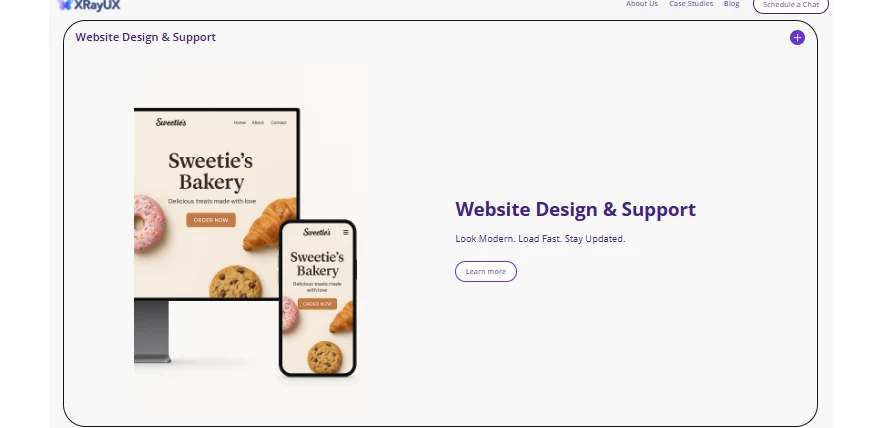
For the consultation-led direction, I organized the website around recognizable needs such as Google Business Profile support, website design and maintenance, and branding. The service descriptions led with what the work could help an owner do. Technical details and scope could follow in the consultation.
06 / Iteration
Make scope and next steps easy to compare
Early Webflow layouts separated descriptions from the included work. That made it harder to tell what each service covered. I would bring the purpose, deliverables, and next step together so an owner can see where to start without piecing the offer together.
07 / Outcome
A different offer, with a clearer purpose
The work produced audit concepts, experiments with packages, and Webflow designs for service pages organized around implementation support. The documented outcome is a change in the service design. The work does not establish conversions, revenue, or client results.
08 / Reflection
Design for what the customer has to do next
The most useful change was questioning the deliverable itself. A clearer audit could help an owner understand the problem. An actionable service needed to account for what they could realistically do after that.
What I would test next: Ask owners to choose a service for a realistic problem and explain what they expect it to include. Where they hesitate or interpret the scope differently would guide the next revision.